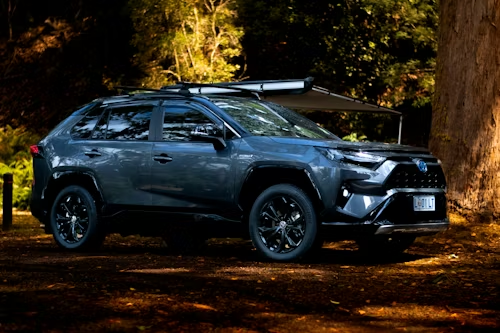
The Toyota RAV4 Prime stands at the intersection of electrification, real-world usability, and surprising performance, redefining what a compact SUV can deliver in 2025. As Toyota’s most powerful RAV4 ever, the plug-in hybrid Prime blends an athletic powertrain with advanced driver-assistance systems and a cabin designed for daily comfort. For young professionals looking for efficiency without compromise, families seeking flexibility and safety, and car enthusiasts curious about electrified performance, the RAV4 Prime presents a compelling balance. What makes it even more interesting is how clearly it improves over the previous generation while holding its own against strong rivals such as the Honda CR-V Hybrid, Hyundai Tucson Plug-in Hybrid, and Ford Escape Plug-in Hybrid.
At the heart of the RAV4 Prime is a 2.5-liter four-cylinder engine paired with dual electric motors and a lithium-ion battery pack, delivering a combined system output of 302 horsepower. That figure is not only significantly higher than the previous RAV4 Hybrid generation, which produced roughly 219 horsepower, but also places the Prime among the quickest vehicles in its segment. Acceleration from 0 to 60 mph takes about 5.7 seconds, a number that would have seemed unrealistic for a compact family SUV only a few years ago. On a quiet suburban road, the instant torque from the electric motors makes pulling away from traffic lights effortless, while on highway on-ramps the surge of combined electric and gasoline power provides confident merging without strain. Compared to competitors such as the Honda CR-V Hybrid, which typically requires over 7 seconds to reach 60 mph, the RAV4 Prime feels genuinely energetic rather than merely adequate.
Driving through dense city traffic highlights the advantage of the Prime’s all-electric capability. With an electric-only range of approximately 42 miles, many daily commutes can be completed without consuming any gasoline. In stop-and-go conditions, the silence and smoothness of EV mode create a relaxed driving environment, reducing fatigue during long urban crawls. Regenerative braking subtly recaptures energy, making deceleration smooth and predictable. When the battery depletes or higher speeds are sustained, the gasoline engine seamlessly engages, maintaining consistent responsiveness. Compared with the previous generation RAV4 Hybrid, which relied more heavily on engine operation at low speeds, the Prime feels more refined and noticeably quieter in urban scenarios.
On the open highway, the RAV4 Prime demonstrates impressive stability and composure. The electronically controlled all-wheel-drive system continuously manages torque distribution, ensuring confident traction during lane changes or sudden maneuvers. Wind and road noise are well suppressed thanks to improved sound insulation and tighter body sealing compared to earlier RAV4 models. Adaptive cruise control and lane-centering assist reduce the workload during long journeys, making extended drives feel less tiring. During a 200-mile highway trip, the Prime maintained stable energy consumption, and its seats provided consistent lumbar support, preventing the stiffness often associated with compact SUVs.
Mountain roads reveal another side of the RAV4 Prime’s personality. While it remains taller and heavier than a performance sedan, its low-mounted battery pack lowers the center of gravity, improving cornering stability compared with the previous generation. Steering feedback is predictable and accurate, making it easy to place the vehicle through sweeping curves. Power delivery remains linear, allowing confident overtaking even on uphill stretches. In comparison, the Ford Escape Plug-in Hybrid, while efficient, feels softer in suspension tuning and less composed when pushed harder through twisty terrain.
Although few owners will take a compact SUV to a track, controlled closed-course testing highlights the Prime’s surprisingly strong acceleration and braking consistency. Repeated acceleration runs demonstrate minimal power fade, while the regenerative braking system works in harmony with the mechanical brakes to maintain stopping confidence. While it cannot rival a dedicated performance vehicle, the Prime’s track composure showcases how electrification can enhance rather than dilute driving enjoyment.
Table 1: Key Powertrain and Performance Specifications
| Model | Powertrain Output | 0–60 mph | Drivetrain | Electric Range |
|---|---|---|---|---|
| Toyota RAV4 Prime (2025) | 302 hp | 5.7 s | AWD | ~42 miles |
| Toyota RAV4 Hybrid (Prev. Gen) | 219 hp | 7.8 s | AWD | N/A |
| Honda CR-V Hybrid | 204 hp | 7.6 s | FWD/AWD | N/A |
| Hyundai Tucson Plug-in Hybrid | 261 hp | 6.9 s | AWD | ~33 miles |
| Ford Escape Plug-in Hybrid | 221 hp | 7.4 s | FWD | ~37 miles |
Beyond performance, the RAV4 Prime integrates a comprehensive suite of smart technologies. The infotainment system features a large touchscreen interface with wireless Apple CarPlay and Android Auto, intuitive voice control, and cloud-based navigation updates. During everyday use, quick response times and logical menu layouts reduce distraction, allowing drivers to focus on the road. Toyota Safety Sense brings adaptive cruise control, lane-keeping assist, blind-spot monitoring, and emergency braking, all calibrated smoothly rather than aggressively. Compared with the previous generation’s infotainment interface, which sometimes felt sluggish and dated, the Prime’s system feels modern, responsive, and user-friendly.
Digital driver displays provide real-time energy flow visualization, showing when the vehicle is operating in EV mode, hybrid mode, or regenerative braking. This feedback encourages efficient driving habits and helps owners understand how their driving style impacts energy consumption. On longer journeys, this system becomes surprisingly engaging, turning efficiency into a kind of driving game without sacrificing comfort or performance.
Interior space and comfort remain strong selling points. The cabin offers generous legroom for both front and rear passengers, making it suitable for family use or group travel. Seat cushioning strikes a balance between support and softness, remaining comfortable even after several hours behind the wheel. Cargo capacity remains competitive despite the battery packaging, accommodating groceries, luggage, or sports equipment without compromise. Compared with the previous RAV4 generation, material quality has improved, with softer touch surfaces, refined stitching, and improved acoustic insulation contributing to a more premium feel.
Table 2: Interior Space and Practicality Comparison
| Model | Front Legroom | Rear Legroom | Cargo Capacity (Seats Up) |
|---|---|---|---|
| RAV4 Prime | 41.0 in | 37.8 in | ~33.5 cu ft |
| RAV4 Hybrid (Prev. Gen) | 41.0 in | 37.8 in | ~37.6 cu ft |
| CR-V Hybrid | 41.3 in | 40.4 in | ~39.3 cu ft |
| Tucson PHEV | 41.4 in | 38.7 in | ~31.9 cu ft |
| Escape PHEV | 42.4 in | 40.7 in | ~33.5 cu ft |
Fuel efficiency remains one of the Prime’s strongest advantages. When fully charged, daily commutes may require no gasoline at all. In hybrid operation, combined fuel economy typically hovers around 38 mpg, which remains competitive within the segment. Electricity costs are significantly lower than gasoline for short-distance commuting, further enhancing total cost of ownership. Compared with non-plug-in hybrids, the Prime provides greater flexibility, especially for urban drivers with access to home or workplace charging.
Table 3: Energy Efficiency Comparison
| Model | Electric Range | Combined MPG/MPGe |
|---|---|---|
| RAV4 Prime | ~42 miles | 94 MPGe / ~38 mpg hybrid |
| Tucson Plug-in Hybrid | ~33 miles | 80 MPGe |
| Escape Plug-in Hybrid | ~37 miles | 100 MPGe |
| CR-V Hybrid | N/A | ~40 mpg |
| Previous RAV4 Hybrid | N/A | ~40 mpg |
From a lifestyle perspective, the RAV4 Prime adapts seamlessly to different usage patterns. A young professional commuting daily in urban traffic benefits from EV mode’s quiet efficiency, while weekend highway trips remain comfortable and stress-free thanks to driver-assistance technologies. Families appreciate the generous cabin space, safety systems, and cargo flexibility for school runs and vacations. Enthusiasts enjoy the unexpected acceleration and confident handling that distinguish the Prime from conventional compact SUVs.
What truly sets the RAV4 Prime apart from both its predecessor and its competitors is how effectively it balances electrification with performance and practicality. While earlier RAV4 hybrids focused primarily on efficiency, the Prime introduces genuine excitement into the driving experience without sacrificing reliability or comfort. Compared with rivals, its stronger acceleration, longer electric range, and refined cabin give it a noticeable edge for buyers seeking a future-ready SUV that does not feel compromised.
In everyday use, the Prime feels like a natural evolution of Toyota’s hybrid expertise, combining maturity with innovation. The transition between electric and gasoline operation is nearly imperceptible, and the driving experience feels cohesive rather than experimental. For drivers who value low operating costs, modern technology, and confident all-weather performance, the RAV4 Prime delivers a remarkably complete package.
For anyone considering a compact SUV that bridges the gap between traditional gasoline vehicles and full electric mobility, scheduling a test drive of the Toyota RAV4 Prime is highly recommended. Experiencing its electric acceleration, quiet urban cruising, and confident highway stability firsthand is the best way to appreciate how effectively this model represents the future of practical performance SUVs.