Battery technology has always been the most talked-about part of the electric vehicle story. Headlines often promise revolutions—solid-state breakthroughs, ultra-fast charging, million-mile batteries—but for everyday EV owners, progress tends to arrive more quietly. By 2026, battery technology has not radically transformed electric cars overnight. Instead, it has evolved in practical, meaningful ways that directly affect range stability, charging behavior, durability, and ownership confidence.
What has actually changed matters less to laboratory benchmarks and more to how electric vehicles fit into real life.
Incremental Progress Replaced the Waiting Game
One of the most important shifts by 2026 is psychological rather than technical. The industry has largely moved away from waiting for a single “next-generation” battery breakthrough. Instead, manufacturers focused on refining existing chemistries, improving thermal control, and optimizing battery management software.
For EV owners, this means fewer dramatic announcements and more consistent real-world improvements. Vehicles released in the last two years feel more predictable, less sensitive to conditions, and easier to live with across seasons.
Energy Density Improved, but Range Stability Improved More
Battery energy density has continued to increase, but not at a pace that dramatically changes vehicle size or range figures. Typical gains remain in the single-digit percentage range year over year. However, what owners notice more is how usable that range has become.
Modern battery packs in 2026 maintain a higher percentage of their rated range in daily driving. Improved cell chemistry and smarter energy buffers reduce sudden drops caused by temperature swings or aggressive acceleration. Drivers are seeing fewer surprises, especially during winter or highway travel.
In practical terms, a 450-kilometer-rated EV in 2026 feels closer to its advertised range than a similar vehicle from four or five years earlier.
Charging Behavior Became Smoother, Not Just Faster
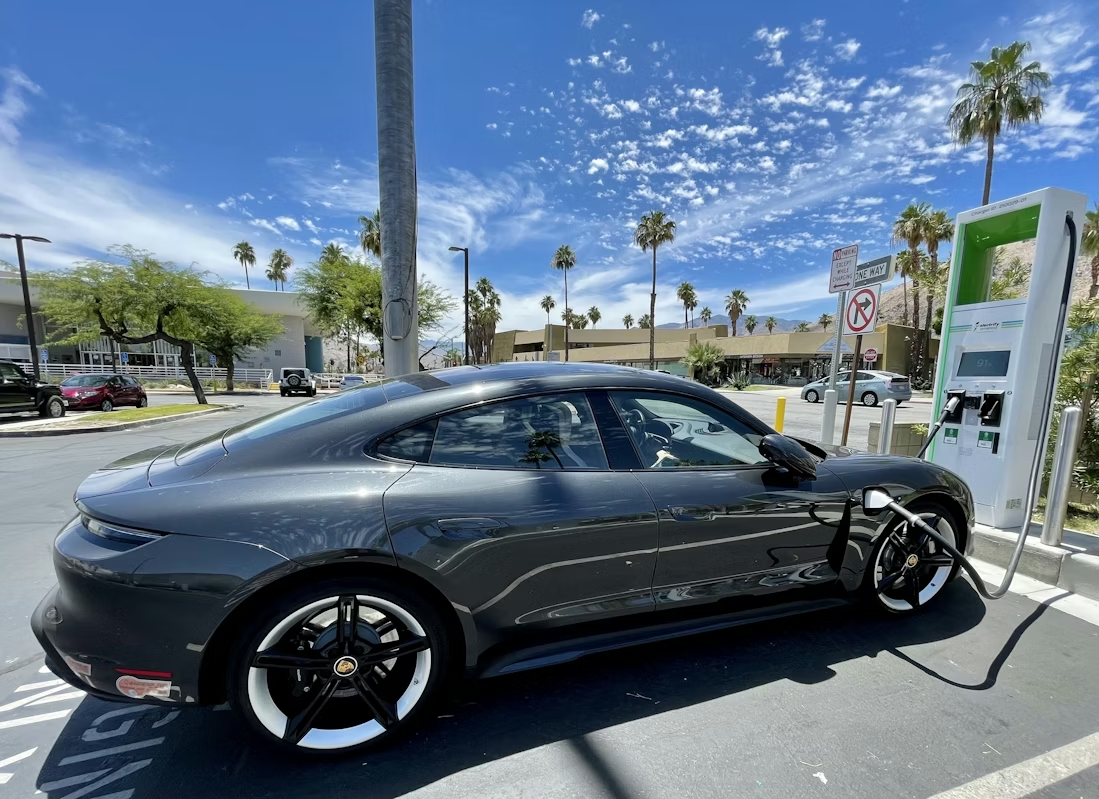
Charging speed is no longer defined only by peak kilowatt numbers. While more vehicles support high-voltage architectures and faster DC charging, the real improvement lies in charging curves.
Newer battery packs hold higher charging speeds for longer periods. Instead of sharp peaks followed by steep slowdowns, charging sessions feel more consistent. This reduces total stop time even if peak numbers look similar on paper.
For EV owners, this translates into less waiting anxiety and more predictable road trip planning. Charging has become less about hitting the perfect battery percentage and more about short, flexible stops.
Thermal Management Quietly Did the Heavy Lifting
Thermal control has emerged as one of the most important behind-the-scenes improvements. Battery packs in 2026 handle both heat and cold more effectively, reducing degradation and improving efficiency.
Cold-weather performance, once a major concern, has become more manageable. While winter still affects range, preconditioning systems now work faster and more intelligently. Battery packs reach optimal temperature sooner, especially when navigating to a fast charger.
In hot climates, improved cooling strategies reduce long-term stress on cells. Owners in warmer regions are seeing more consistent performance across years of ownership.
Battery Longevity Became Less Abstract
Early EV buyers often worried about battery degradation without clear reference points. By 2026, long-term data has changed that conversation.
Modern battery packs show slower and more linear degradation patterns. Five years of ownership no longer implies a noticeable daily impact for most drivers. Improved charge management limits extreme states of charge, and software actively protects cells without requiring user intervention.
For many owners, battery health has shifted from a concern to a background assumption, similar to engine longevity in traditional vehicles.
Chemistry Choices Became More Purpose-Driven
Battery chemistry diversification has accelerated. Rather than chasing a one-size-fits-all solution, manufacturers now choose chemistries based on vehicle role.
Lithium iron phosphate batteries dominate entry-level and high-volume models due to cost stability, durability, and safety. Nickel-based chemistries remain common in long-range and performance vehicles where energy density matters most.
This strategic split benefits owners by aligning battery behavior with usage patterns. City-focused EVs emphasize durability and affordability, while long-distance vehicles prioritize energy density and charging performance.
Solid-State Batteries Stayed in the Background
Despite ongoing development, solid-state batteries remain largely absent from mass-market vehicles in 2026. For EV owners, this is less disappointing than it sounds.
The improvements achieved with existing lithium-ion platforms have reduced the urgency of a disruptive leap. Safety, range, and charging convenience have improved enough that most drivers no longer feel they are waiting for the “real” EV era to begin.
Solid-state technology continues to mature, but its absence has not stalled meaningful progress.
Software Became as Important as the Cells Themselves
Battery hardware no longer operates in isolation. Software plays a central role in how batteries age, charge, and perform.
Advanced battery management systems adjust charging speed, thermal behavior, and energy output based on usage patterns. Over-the-air updates refine these strategies over time, improving efficiency and longevity without physical changes.
For owners, this means their vehicle’s battery performance can improve subtly after purchase, reinforcing confidence rather than depreciation anxiety.
What EV Owners Actually Gained by 2026
The real changes in battery technology are not dramatic leaps but accumulated refinements:
- More stable real-world range
- Faster and more predictable charging sessions
- Reduced sensitivity to weather extremes
- Slower and more transparent degradation
- Better alignment between battery type and vehicle purpose
Electric vehicles in 2026 feel less experimental and more mature. Battery behavior is easier to understand, easier to trust, and easier to integrate into daily routines.
The Quiet Maturity of EV Batteries
Battery technology in 2026 did not redefine electric vehicles overnight. Instead, it made them calmer, more consistent, and more dependable. For EV owners, that matters far more than laboratory milestones.
The biggest change is not what batteries can theoretically do, but how rarely drivers have to think about them anymore. That quiet maturity may be the most important breakthrough of all.