Electric vehicles (EVs) are no longer a niche; they are a defining trend in transportation’s evolution. Alongside battery electric vehicles (BEVs), hydrogen fuel cell electric vehicles (FCEVs) represent a compelling alternative — one that has sparked significant debate among engineers, policymakers, and drivers. At a glance, both technologies promise zero tailpipe emissions and reduced dependence on fossil fuels, but beneath that shared goal lie stark differences in energy efficiency, refueling infrastructure, user experience, and long‑term practicality. For young professionals, families, and car enthusiasts alike, understanding these tradeoffs can clarify which technology better fits real‑world needs today and in the decades ahead.
From the moment an energy molecule or electron is generated to the second torque hits the wheels, the two systems diverge. BEVs store electrical energy directly in a battery pack and use power electronics to drive electric motors. Hydrogen FCEVs generate electricity onboard by combining hydrogen gas with oxygen in a fuel cell stack; the resulting electrical power feeds motors much like a BEV, but with hydrogen as the energy carrier. These distinct approaches give rise to unique strengths and limitations that shape everything from efficiency and refueling time to infrastructure demands and lifecycle cost.
How the Technologies Work and Where They Differ
Battery electric vehicles rely on large lithium‑ion battery packs that hold electric charge. Charging stations — whether slow Level 2 home units or public fast chargers — replenish these batteries. The stored energy flows through inverters and controllers into one or more electric motors, which convert electrical energy into motion. This direct storage and utilization path underpins BEVs’ efficiency advantages.
In contrast, FCEVs store energy in the form of compressed hydrogen gas, typically at 700 bar pressure. Hydrogen flows into a fuel cell, where a chemical reaction with oxygen produces electricity, heat, and water vapor. The electricity then drives an electric motor much like in a BEV. Because hydrogen must be produced, compressed, transported, and stored, each of these stages consumes energy and influences overall efficiency.
The schematic below illustrates the basic difference: electrons stored in a battery vs. electricity generated from hydrogen onboard.
(Insert Diagram Here: Energy Flow Paths in BEV vs FCEV — from source to wheels)
While both architectures convert chemical energy into motion without tailpipe CO₂, the number of energy conversions differs significantly. BEVs typically involve fewer stages: grid electricity → battery → motor → wheels. FCEVs involve additional stages: electricity generation → hydrogen production and compression → storage and transport → onboard fuel cell conversion → motor → wheels. Each added stage introduces energy losses and complexity.
Energy Efficiency: Why BEVs Lead Today
The most measurable tradeoff between these powertrains emerges in efficiency. Energy efficiency describes how much of the original energy source actually contributes to propulsion. BEVs are widely acknowledged to be markedly more efficient than hydrogen FCEVs.
In simplified terms, electricity supplied to a BEV’s battery can be used with about 85–90% efficiency, while hydrogen consumed in an FCEV often results in only 30–40% efficiency when accounting for production and compression losses. The following chart captures the general difference:
Energy Efficiency Comparison (Source → Wheels)
| Stage | BEV (Grid → Wheels) | FCEV (Hydrogen Chain → Wheels) |
|---|---|---|
| Primary Conversion (Source) to Stored Energy | ~95% | ~75% (electrolysis) |
| Storage & Delivery | ~90% | ~60% (compression & transport) |
| Onboard Conversion to Motion | ~90% | ~50% (fuel cell + motor) |
| Total System Efficiency | ~75–85% | ~25–40% |
This simplified comparison demonstrates why electric vehicles require less energy per mile and typically enjoy lower operating costs per kilometer. A BEV draws directly from the electrical grid with minimal conversion losses, while hydrogen must be manufactured and moved before it can ever generate power onboard.
It’s worth noting that hydrogen proponents argue that green hydrogen — produced via renewable energy electrolysis — can store excess renewable generation and serve as a stable energy carrier for sectors that are hard to electrify. Nevertheless, for passenger vehicles in the near term, the energy advantage of BEVs is clear.
Refueling and Charging: Speed vs. Practicality
Refueling experience is often the first real‑world touchpoint for drivers. For many gasoline drivers switching to electric power, the time it takes to “fill up” is a major concern.
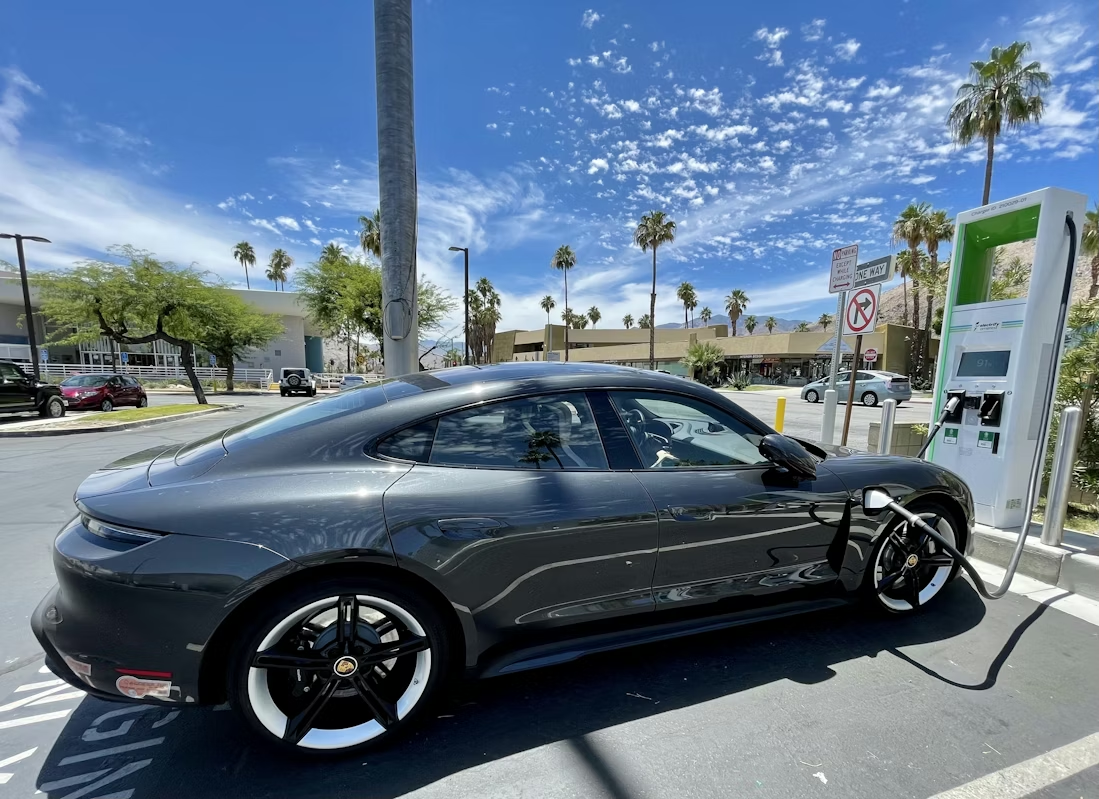
Hydrogen FCEVs promise refueling times that closely mimic conventional gasoline vehicles: a press of the nozzle, and 5–10 minutes later you’re on your way with a full hydrogen tank. In contrast, BEVs exhibit a broader range of charging times. Overnight home charging easily delivers a full charge in 6–12 hours; public DC fast chargers can add 80% range in 20–45 minutes depending on battery size and station power.
In daily use, most BEV drivers recharge at home, waking up to a full battery — a convenience that aligns with regular lifestyle patterns. For long trips, DC fast charging becomes essential, and its speed continues to improve with high‑power chargers (350 kW+) and optimized battery thermal management.
For hydrogen, while station refueling is quick, the number of available stations remains very limited outside certain regions such as California, Japan, and parts of Europe. This scarcity influences trip planning and perceived convenience in ways that fast charging for BEVs does not, simply because fast chargers are more widespread and growing rapidly with OEM and utility infrastructure investments.
Infrastructure: The Catch‑22 of Deployment
Infrastructure deployment reveals stark differences between BEVs and FCEVs. Battery electric charging stations have proliferated globally, supported by governments, utilities, and private operators. Fast chargers are being added along major highways and in urban centers at a pace that matches EV adoption trends, fueled by clear regulatory direction and the relative simplicity of grid connection.
Hydrogen refueling stations, by contrast, require high‑pressure storage, certified safety systems, and complex supply chains for hydrogen delivery. Building such stations is expensive — often millions of dollars apiece — and the limited number of hydrogen vehicles on the road reduces the business case for operators. The result is a classic chicken‑and‑egg problem: without many FCEVs, station build‑out is slow; without a robust station network, FCEV adoption is constrained.
A recent comparison chart from industry analyses shows approximate station counts in major markets:
Public Fast Charging & Hydrogen Station Deployment (2025 Estimates)
| Region | DC Fast Chargers | Public Hydrogen Stations |
|---|---|---|
| North America | ~150,000+ | ~100+ |
| Europe | ~200,000+ | ~400+ |
| East Asia | ~180,000+ | ~750+ |
| Global Total | ~530,000+ | ~1,250+ |
Even in regions with strong hydrogen support, fast chargers outnumber hydrogen stations by orders of magnitude. For consumers, this translates into ease of finding a charger vs difficulty locating a hydrogen pump when needed.
Cost Tradeoffs: Ownership and Operating Expenses
Cost contributes greatly to the appeal of any powertrain. For BEVs, the cost of electricity per mile is typically much lower than the cost of gasoline and, in most regions, lower than the cost of hydrogen per mile. Residential electricity rates, when combined with time‑of‑use billing or renewable tariffs, often make charging overnight economical compared with public fast charging. Hydrogen, due to production, compression, and delivery costs, remains relatively expensive and varies widely by market.
Battery costs have been declining steadily thanks to scale and technology advances. While BEVs generally require a larger upfront battery investment than FCEVs require a fuel cell stack, economies of scale in BEV manufacture — along with simplified drivetrain components — contribute to cost parity projections within the next decade.
On the maintenance side, BEVs benefit from fewer moving parts and less frequent brake wear due to regenerative braking. FCEVs add complexity through additional high‑pressure hydrogen components and fuel cell stacks that require long‑term durability assurance.
Performance Differences and Driving Experience
Drivers often ask how the technologies compare in real driving. BEVs boast instant torque delivery, making acceleration smooth and powerful from standstill to highway merge. Tesla, Ford, Hyundai, and other EV leaders showcase sub‑4‑second 0–60 mph times even in non‑performance trims. Hydrogen FCEVs — such as Toyota’s Mirai or Hyundai’s Nexo — deliver quiet, linear acceleration without the range anxiety associated with smaller battery EVs. However, peak power figures for mainstream FCEVs tend to lag behind the highest‑output BEVs because the technology has been optimized for fuel economy and emissions rather than sport performance.
Ride comfort and NVH (noise, vibration, harshness) tend to be similar in both architectures, since both rely on electric motors for propulsion. Sound insulation, suspension tuning, and cabin ergonomics remain differentiators more tied to vehicle design than powertrain choice.
Safety and Lifecycle Considerations
High‑pressure hydrogen storage raises specific safety engineering challenges. Tanks must withstand rigorous crash forces while containing gaseous hydrogen at very high pressures. Modern FCEVs meet these standards through layered tank designs and multiple safety redundancies.
Conversely, BEVs carry risks associated with high‑energy batteries that require sophisticated thermal management systems to prevent thermal runaway. In both cases, engineering emphasis is on preventing and mitigating rare but high‑impact failure modes.
Lifecycle environmental impact also factors into the broader discussion. BEV emissions depend on grid carbon intensity, and as grids decarbonize, the environmental advantage deepens. Hydrogen’s impact varies with production methods: green hydrogen (via renewables) offers dramatic lifecycle benefits, but gray or blue hydrogen (from fossil sources) offers less clear advantages.
What This Means for Drivers Today
For most consumers in 2025, the tradeoffs between hydrogen and battery electric powertrains translate into tangible daily benefits and constraints. BEVs offer high efficiency, rapidly expanding charging infrastructure, and decreasing total cost of ownership. They meet the needs of city commuters, long‑distance travelers, and performance seekers with a variety of models across price points. The convenience of home charging — paired with ever‑faster public fast chargers — means that recharging is increasingly integrated into daily routines rather than requiring special planning.
FCEVs, on the other hand, shine in areas where refueling speed and long range without frequent stops are priorities, particularly in commercial fleets or regions with developed hydrogen infrastructure. They promise fast fill‑ups similar to gasoline vehicles and can alleviate range anxiety without large battery packs. However, the limited station network and higher production costs currently constrain widespread adoption.
As both technologies continue to evolve, the landscape may shift further. Advances in battery chemistry (such as solid‑state cells), renewable hydrogen production, and power electronics could blur the lines between today’s tradeoffs. For drivers making purchasing decisions today, the choice often comes down to infrastructure availability, daily driving patterns, and long‑term cost expectations.
Adopting an EV — whether battery or hydrogen — means embracing a future with lower emissions, greater energy diversity, and a vastly different relationship with fueling and maintenance. Scheduling a test drive, exploring local charging or refueling networks, and calculating true operating costs over the vehicle’s lifecycle are practical next steps for anyone considering the transition to electric mobility today.