Electric vehicles (EVs) have revolutionized personal transportation, but charging habits remain one of the most critical factors affecting ownership experience. The debate between fast charging and home charging extends beyond mere convenience, touching on cost, battery longevity, daily routines, and even long-term vehicle value. Understanding the trade-offs is essential for both new EV owners and seasoned enthusiasts who want to maximize efficiency while preserving battery health.
Home Charging: Convenience and Cost-Effectiveness
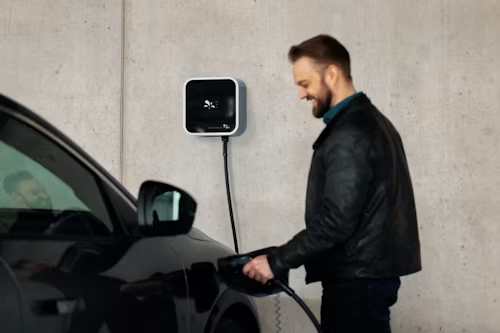
Home charging has become the default method for most EV owners, especially those with predictable commuting patterns. Plugging in overnight allows the vehicle to draw power at lower rates, typically using Level 1 or Level 2 chargers. For a daily commuter traveling 40 to 60 miles, this method is more than sufficient to restore a full charge by morning.
From a financial perspective, home charging is typically cheaper than public fast chargers. Electricity rates at residential locations are generally lower than those at commercial fast-charging stations. Smart charging features allow owners to schedule charging during off-peak hours, further reducing costs. Over time, these savings accumulate, making home charging the most economical option for routine use.
Home charging also provides the advantage of consistency. Batteries benefit from slower, steady charging, which generates less heat and reduces chemical stress on cells. This slower process contributes to longer battery lifespan and better retention of range over the years. Drivers who rely primarily on home charging often report minimal signs of degradation even after 80,000 to 100,000 miles of use.
Fast Charging: Speed and Flexibility
Fast charging, often referred to as DC fast charging or Level 3 charging, prioritizes speed and convenience. It allows vehicles to recover up to 80% of battery capacity in as little as 20 to 40 minutes, depending on the model and charging station. For long trips, urban errands, or emergency situations, fast charging is invaluable. It enables EV owners to extend their travel range quickly without planning multiple hours of downtime.
However, fast charging introduces trade-offs that require careful consideration. Rapid charging generates significantly higher heat within the battery, which can accelerate chemical degradation if used excessively. Most EV manufacturers mitigate this by implementing thermal management systems that regulate temperature, but frequent fast charging is still associated with a faster loss of maximum range compared to slow, consistent charging.
In terms of cost, fast charging is usually more expensive per kilowatt-hour than home electricity rates. Public charging networks often price based on speed or per-minute usage. Drivers who rely heavily on fast charging may notice the cumulative cost difference over time. Despite the convenience, this factor makes it less economical for daily use compared with home charging.
Daily Convenience and Lifestyle Implications
Choosing between home and fast charging often comes down to lifestyle. For suburban commuters with reliable overnight parking and predictable routes, home charging aligns perfectly with daily routines. Plugging in each night ensures a full battery by the morning without requiring additional stops, which is convenient and stress-free.
Urban residents, particularly those without private parking, often depend on public fast chargers. In dense cities, it may not be possible to install a Level 2 charger at home, making fast charging the primary solution. For them, convenience outweighs cost concerns, but they must balance charging habits to minimize battery wear.
Travel patterns also influence the optimal approach. On long-distance trips or road trips with multiple charging stops, fast chargers are indispensable. Meanwhile, home charging remains ideal for daily short trips and predictable commutes. Many EV owners adopt a hybrid strategy, relying primarily on home charging while reserving fast charging for occasional travel.
Battery Degradation and Long-Term Considerations
Scientific studies and real-world data show that battery degradation rates differ between fast charging and slow home charging. Slow charging produces lower internal heat and stress, maintaining a healthier chemical balance within battery cells. In contrast, repeated exposure to high-speed DC charging can increase microstructural changes in the battery electrodes, slightly reducing total lifespan over several years.
Most modern EVs incorporate battery management systems that intelligently limit charging speed and thermal exposure, mitigating damage. Nevertheless, owners who prioritize battery longevity generally use fast charging sparingly. Understanding this dynamic allows drivers to develop charging habits that balance convenience, cost, and longevity.
Environmental and Efficiency Impacts
Beyond cost and battery health, charging choices also affect efficiency. Home charging during off-peak hours can draw cleaner, renewable energy depending on the grid mix, while fast chargers may operate during peak demand, potentially relying on fossil fuel-based electricity. By aligning charging schedules with low-carbon energy availability, owners contribute to more sustainable EV operation.
Real-World Scenarios
Consider a young professional commuting 50 miles each day in a city apartment without a private garage. Their daily routine likely relies on public Level 2 or fast chargers. Planning charging around work or errands ensures adequate range, but careful monitoring of fast charging frequency is important to maintain battery health. Meanwhile, a family living in the suburbs with a dedicated home charger enjoys a stress-free routine: plug in overnight, drive to work, return home, repeat. The home charging approach is cost-efficient and promotes long-term battery retention.
EV enthusiasts who enjoy long drives or weekend road trips often integrate both approaches. Home charging handles daily energy needs, while fast charging fills gaps during multi-hour trips. Balancing these methods optimizes convenience, cost, and battery longevity, demonstrating the versatility of EV charging strategies.
Finding the Right Balance
Ultimately, there is no universal answer to whether fast charging or home charging is “better.” Each approach has its advantages and drawbacks, and the optimal strategy depends on driving habits, parking access, commuting distance, and personal priorities. The key lies in understanding the trade-offs: home charging preserves battery life and lowers cost, while fast charging offers unmatched convenience and flexibility for occasional long-distance use.
For responsible EV owners, combining the two approaches provides the best overall experience. Home charging handles routine energy needs efficiently and safely, while occasional fast charging supports long trips or emergencies. Awareness of battery health, charging schedules, and cost implications allows drivers to make informed decisions that maximize convenience without sacrificing longevity.
Optimizing Your EV Charging Routine
EV charging is more than a technical task; it shapes the overall ownership experience. Understanding how home charging and fast charging differ allows drivers to make informed choices that balance convenience, cost, and battery longevity. For daily commuting, home charging provides a stress-free, economical, and battery-friendly solution. Fast charging, on the other hand, delivers flexibility and speed when longer trips or unexpected errands demand it.
By combining these approaches thoughtfully, EV owners can maintain efficiency, preserve battery health, and enjoy reliable performance over the long term. Observing how charging habits affect the vehicle in real-world scenarios helps drivers adapt strategies that suit their lifestyle while protecting their investment. Ultimately, mastering the balance between fast and home charging ensures a smoother, more confident, and satisfying EV ownership journey.