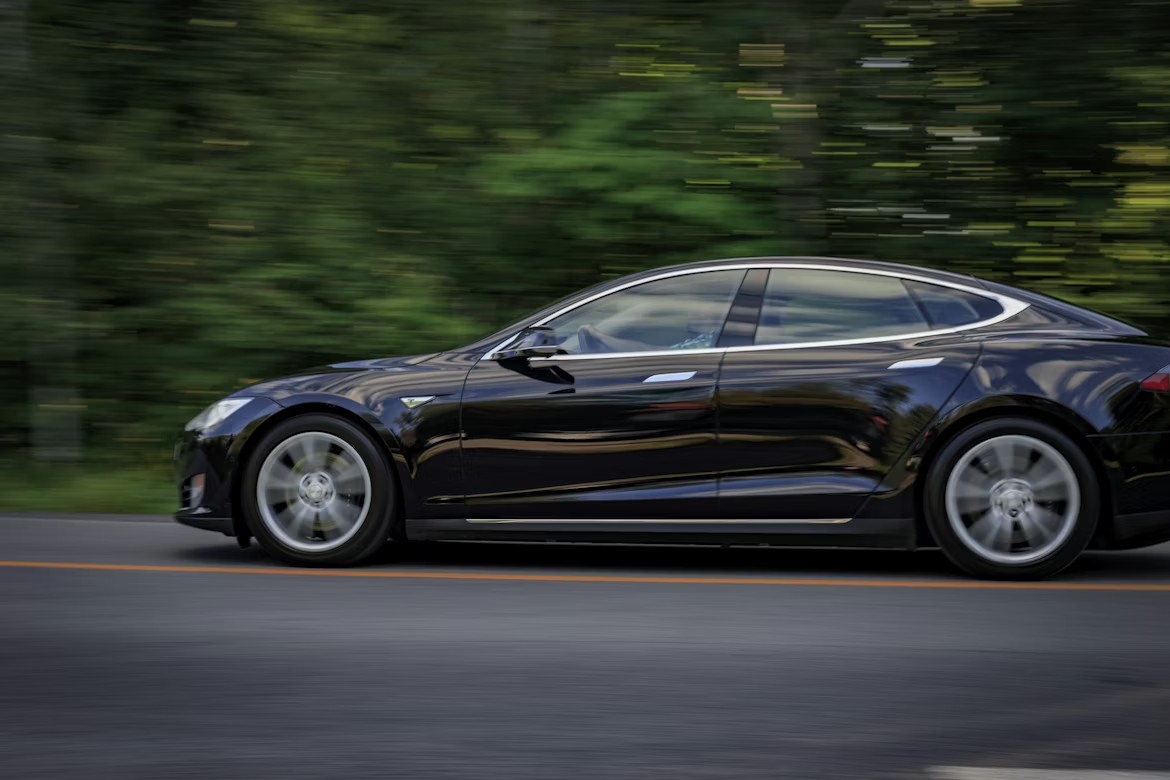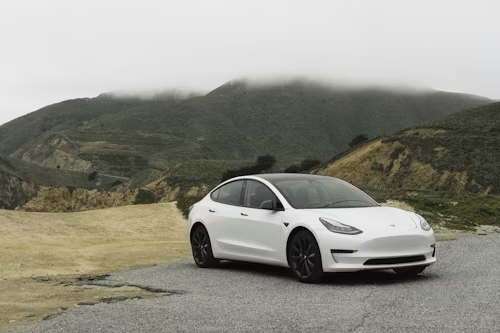
The Tesla Model 3 has become one of the most influential vehicles of the past decade, not only shaping public perception of electric cars but also redefining what drivers expect from a modern compact sedan. Positioned between affordability and advanced technology, the Model 3 targets young professionals, tech-savvy families, and driving enthusiasts who value performance, efficiency, and a forward-looking lifestyle. Compared with its earlier iterations and direct competitors such as the BMW i4, Hyundai Ioniq 6, and Polestar 2, the current Model 3 feels more mature, more refined, and more confidently aligned with real-world driving needs.
At the core of the Model 3 experience is its electric powertrain, which delivers instant torque and linear acceleration that fundamentally changes how the car feels in daily driving. Even in its rear-wheel-drive configuration, the Model 3 responds immediately to throttle inputs, making city driving effortless. Pulling away from traffic lights or navigating busy intersections feels smooth and decisive, without the hesitation common in many internal combustion vehicles. In the dual-motor Long Range and Performance versions, acceleration becomes a defining character trait rather than a mere specification. A 0–60 mph time as quick as 3.1 seconds in the Performance variant places the Model 3 firmly in sports sedan territory, outperforming many traditional performance cars while remaining quiet and vibration-free.
City commuting highlights the strengths of the Model 3’s electric architecture. Stop-and-go traffic becomes less stressful thanks to one-pedal driving, where regenerative braking slows the car naturally as the accelerator is released. Over time, this driving style feels intuitive and reduces physical fatigue, especially during long urban commutes. Compared with earlier Model 3 generations, regenerative braking calibration feels smoother and more predictable, making low-speed maneuvers and parking easier to manage. Against rivals such as the BMW i4, which retains a more traditional braking feel, the Model 3 emphasizes simplicity and efficiency.
Highway cruising further demonstrates the Model 3’s balance between performance and comfort. At sustained speeds, the cabin remains impressively quiet, with minimal wind and road noise, particularly in the latest revisions that improved insulation and glass thickness. Adaptive cruise control and lane-centering assist reduce mental workload during long trips, making the car feel like a capable long-distance companion rather than just a city-focused EV. During extended highway drives, the low center of gravity provided by the battery pack enhances stability, giving the Model 3 a planted and confident feel even at higher speeds.
Mountain roads reveal another layer of the Model 3’s character. Steering is direct and responsive, allowing precise placement through tight curves. The instant torque delivery exiting corners provides a sense of control and engagement that traditional turbocharged engines often struggle to replicate. While suspension tuning remains firm, it strikes a balance between handling sharpness and daily comfort. Compared with competitors like the Polestar 2, which leans toward a heavier, more solid feel, the Model 3 feels lighter on its feet and more playful on winding roads.
Track testing, while not the primary use case for most owners, showcases the engineering depth of the Model 3 Performance. Repeated acceleration runs demonstrate consistent power delivery, while the upgraded brakes and suspension maintain composure under hard driving. Thermal management plays a crucial role here, and Tesla’s battery cooling system ensures stable performance during spirited sessions. While it may not replace a dedicated track car, the Model 3 proves that electric sedans can deliver repeatable performance without compromising reliability.
Table 1: Powertrain and Performance Specifications
| Model | Power Output | 0–60 mph | Drivetrain | Top Speed |
|---|---|---|---|---|
| Tesla Model 3 RWD | ~283 hp | ~5.8 s | RWD | ~140 mph |
| Tesla Model 3 Long Range | ~425 hp | ~4.2 s | AWD | ~145 mph |
| Tesla Model 3 Performance | ~510 hp | ~3.1 s | AWD | ~162 mph |
| BMW i4 eDrive40 | 335 hp | ~5.5 s | RWD | ~118 mph |
| Polestar 2 Dual Motor | 421 hp | ~4.5 s | AWD | ~127 mph |
Technology remains the defining hallmark of the Model 3. The minimalist interior centers around a large touchscreen that controls nearly all vehicle functions, from navigation and climate control to driving settings and entertainment. While this approach initially divides opinion, extended use reveals its logic and efficiency. The interface is responsive, visually clean, and frequently updated through over-the-air software improvements. Compared with earlier versions, the current system feels faster and more polished, reducing the learning curve for new owners.
Driver-assistance features, including Autopilot and optional Full Self-Driving capabilities, further enhance the Model 3’s appeal. In daily use, lane-keeping assistance and adaptive cruise control function smoothly, particularly on highways. Real-world scenarios such as long commutes or late-night drives benefit from reduced driver fatigue, although active supervision remains essential. Compared with competitors’ ADAS systems, Tesla’s strength lies in continuous software evolution rather than static feature sets.
Interior space and comfort reflect thoughtful packaging. Despite its sleek exterior profile, the Model 3 offers generous legroom for both front and rear passengers, making it suitable for families or frequent ride-sharing. The flat floor enhances rear-seat comfort, while the trunk and front trunk together provide versatile cargo capacity for groceries, luggage, or weekend trips. Compared with the previous generation, improvements in seat cushioning and material quality give the cabin a more refined and welcoming feel.
Table 2: Interior Space and Practicality Comparison
| Model | Front Legroom | Rear Legroom | Cargo Capacity |
|---|---|---|---|
| Tesla Model 3 | 42.7 in | 35.2 in | ~23 cu ft (incl. frunk) |
| BMW i4 | 41.6 in | 34.2 in | ~17 cu ft |
| Hyundai Ioniq 6 | 45.4 in | 37.9 in | ~11.2 cu ft |
| Polestar 2 | 41.3 in | 36.7 in | ~15.5 cu ft |
Efficiency remains a cornerstone of the Model 3’s appeal. Depending on configuration, EPA-estimated range reaches up to approximately 333 miles, making it suitable for both daily commuting and long-distance travel. Access to Tesla’s Supercharger network further reduces range anxiety, enabling quick and convenient charging during road trips. Compared with earlier Model 3 versions, charging speeds and energy management have improved, making ownership more convenient and predictable.
Table 3: Range and Efficiency Comparison
| Model | EPA Range | Efficiency |
|---|---|---|
| Tesla Model 3 RWD | ~272 miles | ~132 MPGe |
| Tesla Model 3 Long Range | ~333 miles | ~134 MPGe |
| BMW i4 eDrive40 | ~301 miles | ~109 MPGe |
| Hyundai Ioniq 6 | ~361 miles | ~140 MPGe |
| Polestar 2 | ~276 miles | ~107 MPGe |
From a lifestyle perspective, the Model 3 adapts seamlessly to diverse usage patterns. Young professionals benefit from low operating costs, advanced connectivity, and a modern design that aligns with a tech-forward image. Families appreciate the safety features, spacious cabin, and predictable daily charging routine. Driving enthusiasts find satisfaction in the instant acceleration and balanced handling that challenge traditional assumptions about electric vehicles.
What distinguishes the Model 3 from both its earlier generations and its competitors is its holistic approach. It does not rely solely on performance, range, or technology, but instead integrates all three into a cohesive experience that feels intuitive and future-ready. Compared with rivals that excel in isolated areas, the Model 3 delivers a well-rounded package that continues to evolve through software updates rather than aging into obsolescence.
Living with the Model 3 over time reinforces its strengths. Daily commutes become quieter and more efficient, long trips feel less demanding, and ownership feels dynamic thanks to continuous improvements. While it may not satisfy every preference, particularly for those who favor traditional interiors, it remains one of the most compelling electric sedans available today.
For drivers considering a transition to electric mobility without sacrificing performance or practicality, scheduling a test drive of the Tesla Model 3 is a logical next step. Experiencing its instant torque, refined highway manners, and intuitive technology firsthand offers the clearest insight into why it continues to set the benchmark for modern electric sedans.