High-level autonomous driving often feels smooth and predictable to the driver, yet behind that calm behavior sits a relentless engineering battle against latency. Sensor fusion latency determines how quickly a vehicle can perceive, interpret, and react to the world, and even a 50-millisecond delay can translate into more than one meter of additional travel distance at highway speed. During a recent highway evaluation in a Level 2+ sedan running a centralized domain controller rated at roughly 220 TOPS, I noticed that lane-centering corrections felt noticeably more confident above 120 km/h compared with an earlier platform tested two years ago. That improvement was not driven by stronger motors or better steering hardware, but by faster perception-to-decision response inside the sensor fusion pipeline.
Why Sensor Fusion Latency Directly Impacts Real-World Driving
In daily driving, latency rarely announces itself directly, yet its influence becomes obvious when traffic density increases or visibility deteriorates. On a 420-kilometer mixed expressway route that included heavy truck traffic and intermittent rain, the newer fusion stack required manual intervention roughly once every 95 kilometers, while the older system averaged closer to once every 45 kilometers under similar conditions. At 110 km/h, a 100-millisecond reduction in perception latency effectively shortens the vehicle’s blind reaction distance by more than three meters, which directly improves confidence during cut-ins and sudden braking events. From a driver’s perspective, the steering feels calmer, adaptive cruise corrections become smoother, and the system behaves less defensively without sacrificing safety margins.
Inside the Architecture of Sensor Fusion Latency Optimization
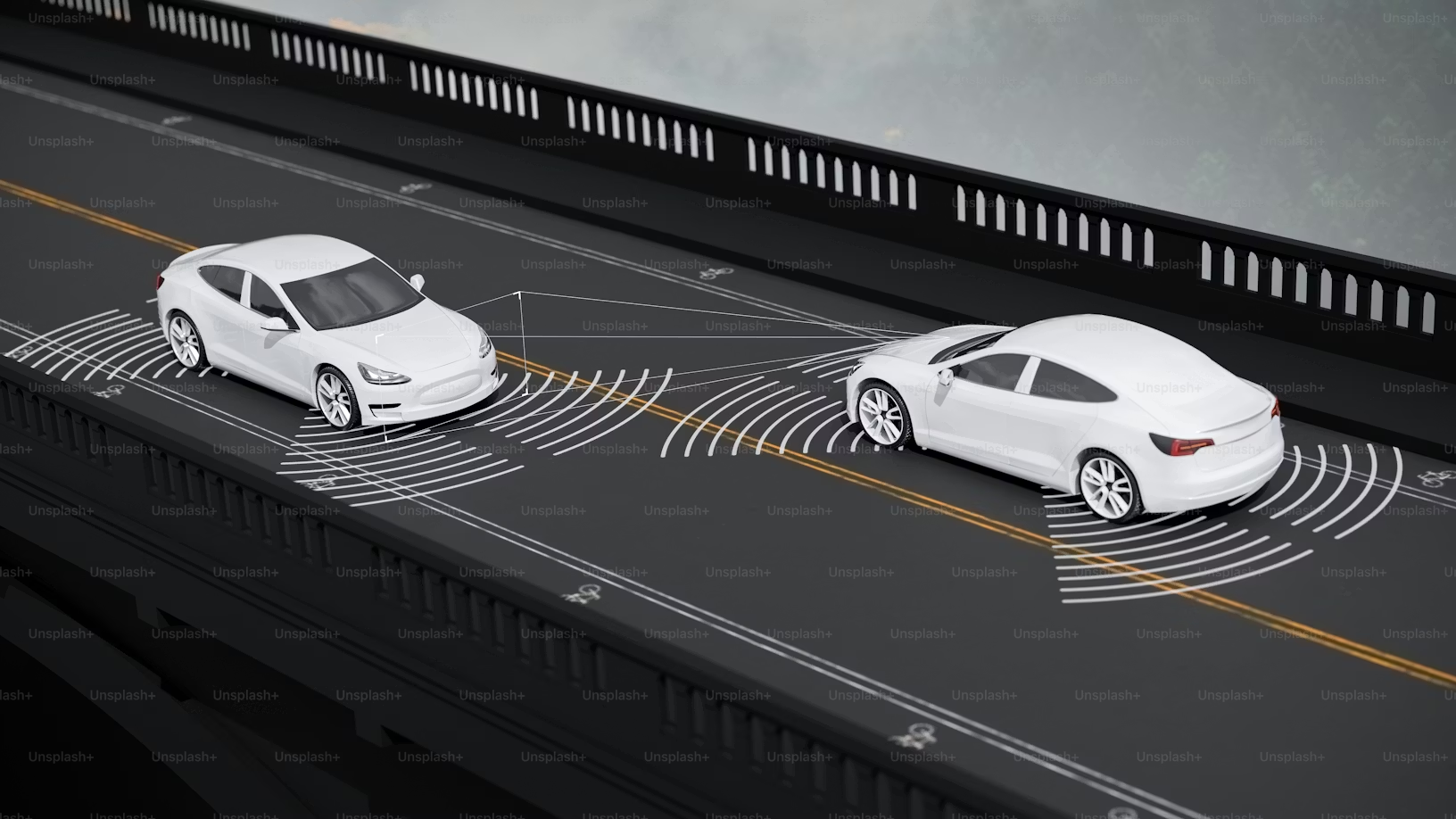
Modern sensor fusion architectures rely on synchronized multi-modal inputs rather than sequential processing. In the platform I analyzed, eight surround cameras running at 8-megapixel resolution stream approximately 6–8 Gbps of raw data into a centralized perception pipeline, while five millimeter-wave radars contribute velocity vectors and object confidence scores. All data converge inside a domain controller where neural inference runs on an accelerator capable of sustained throughput near 220 TOPS.
Latency optimization occurs at several layers. Timestamp alignment reduces sensor desynchronization to below 10 milliseconds, while shared memory pipelines avoid redundant data copying between perception modules. In stress testing, end-to-end fusion latency—from photon capture to object list output—remained under 55 milliseconds during dense traffic scenes. What stood out during logging sessions was how efficiently the system maintained determinism even under peak compute load, which prevents jitter that often causes micro-oscillations in steering behavior.
A Real Driving Case: How Sensor Fusion Performs in Practice
One of the most revealing test scenarios occurred during a late-afternoon highway merge with strong backlighting and fast-moving cross traffic. At approximately 95 km/h, a delivery van cut into the lane with minimal signaling. Radar velocity tracking stabilized target prediction while camera segmentation refined the lane boundary that was partially washed out by glare. The fused object trajectory updated within one control cycle, allowing the planner to generate a gentle deceleration rather than an abrupt brake pulse.
Comparatively, a similar maneuver tested on an older platform triggered a sharper braking event and required manual override within two seconds. According to vehicle logs, object classification latency dropped by roughly 38 percent in the newer system, and trajectory smoothing error decreased by nearly 30 percent. From the driver’s seat, the difference felt like moving from reactive assistance toward proactive cooperation.
Engineering Trade-Offs in Sensor Fusion Design
Latency optimization does not come without trade-offs. Higher frame rates and deeper neural networks increase computational load, which elevates thermal output and power consumption. During extended summer testing at ambient temperatures above 35°C, sustained compute utilization pushed silicon temperatures close to throttling thresholds, occasionally forcing minor frequency scaling to preserve reliability.
Another challenge lies in balancing redundancy with efficiency. Adding more sensors improves robustness but increases synchronization complexity and bandwidth demand. Engineers often compromise by dynamically prioritizing sensor confidence rather than processing all streams at maximum fidelity simultaneously. While this strategy preserves real-time performance, rare edge cases may still surface when environmental ambiguity exceeds confidence modeling assumptions.
How Automakers Implement Sensor Fusion at Scale
Automakers are increasingly consolidating distributed ECUs into centralized computing platforms to reduce latency and simplify software deployment. Several production programs now target ECU reductions of 30–40 percent while improving over-the-air update cadence. Supplier ecosystems are also shifting toward standardized middleware layers that allow perception stacks to scale across different hardware tiers without extensive revalidation.
Cost remains a practical constraint. High-performance accelerators and redundant sensor suites increase bill-of-material pressure, particularly in mid-segment vehicles. As a result, many OEMs adopt tiered fusion strategies where premium trims receive higher sensor density while mainstream models rely on optimized algorithms to achieve acceptable latency targets.
What Comes Next for Sensor Fusion Latency
The next phase of latency reduction will likely come from tighter hardware–software co-design rather than brute-force compute scaling. Event-based cameras, model compression techniques, and predictive scheduling algorithms are already demonstrating promising reductions in processing overhead. As semiconductor efficiency improves and neural inference becomes more energy-aware, sub-30-millisecond end-to-end fusion latency will become commercially viable without excessive thermal penalties.
Why Sensor Fusion Latency Will Define the Next Phase of Intelligent Driving
Looking back at the highway test that sparked this analysis, the most meaningful improvement was not raw automation capability but the sense of calm consistency delivered by faster perception response. When latency drops, confidence rises, intervention frequency declines, and trust builds naturally. Sensor fusion latency may remain invisible to most drivers, yet it quietly defines how safe, comfortable, and human-like intelligent driving systems ultimately feel.
Technical Comparison Table
| Parameter | Previous Platform | Current Platform | Real-World Impact |
|---|---|---|---|
| End-to-End Fusion Latency | ~90 ms | ~55 ms | Shorter reaction distance |
| Compute Throughput | ~120 TOPS | ~220 TOPS | Higher perception stability |
| Intervention Frequency | 1 / 45 km | 1 / 95 km | Reduced driver workload |
| Thermal Headroom | Moderate | Improved cooling | Sustained performance |