BMW’s M division is not simply a ladder of increasing horsepower, but a carefully engineered performance spectrum. From the compact and highly focused M2 to the technologically advanced and immensely powerful M5, each model reflects a different solution to the same engineering challenge: how to balance power delivery, vehicle mass, chassis control, and driver involvement. Understanding these differences requires looking beyond acceleration figures and examining how drivetrain architecture, torque management, weight distribution, and suspension tuning interact as an integrated system.
The BMW M2 represents the purest mechanical interpretation of modern M performance. Its 3.0-liter twin-turbocharged inline-six engine produces roughly 460–480 horsepower and approximately 550–600 Nm of torque depending on specification, delivering strong mid-range response without overwhelming the rear tires. With a curb weight around 1,700 kg and a relatively short wheelbase, the M2 maintains low rotational inertia, allowing rapid direction changes and high steering fidelity. The rear-wheel-drive layout preserves throttle steerability and predictable yaw behavior at the limit, which is particularly valuable for skilled drivers on track or technical mountain roads. Acceleration to 100 km/h occurs in about 4.0 seconds, but its defining strength lies in feedback clarity, front-axle grip, and chassis transparency rather than raw straight-line speed. Suspension calibration favors firm body control and fast damping response, trading some ride compliance for precision and consistency under high lateral load.
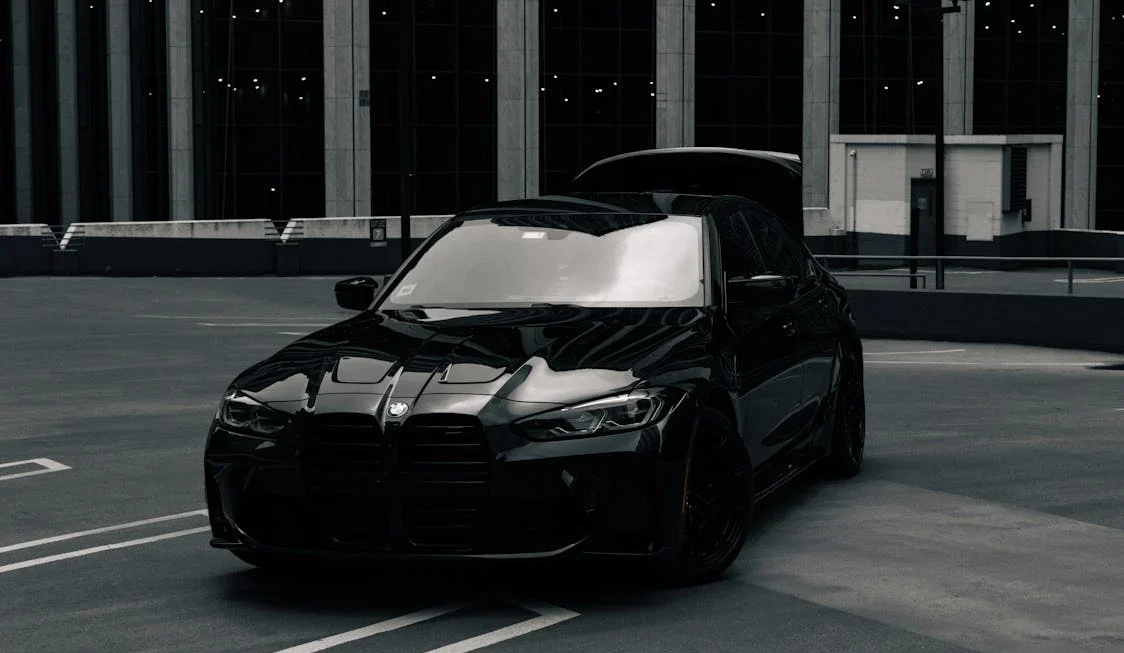
At the opposite end of the spectrum, the BMW M5 operates as a high-performance systems integration exercise rather than a lightweight driver’s car. Its twin-turbocharged V8 combined with an electric motor generates approximately 720+ horsepower and up to 1,000 Nm of system torque, requiring advanced torque distribution strategies to maintain traction and stability. The M xDrive all-wheel-drive system continuously modulates front-to-rear torque split, enabling sub-3.6-second 0–100 km/h acceleration while preserving directional stability under full load. Vehicle mass exceeds two metric tons due to the hybrid system, structural reinforcement, cooling capacity, and luxury equipment, placing higher demands on braking thermal management, tire load capacity, and suspension control. Adaptive dampers, active anti-roll control, and intelligent energy management compensate for this mass, delivering surprisingly agile response for a large executive sedan while maintaining long-distance comfort and refinement.
Between these two extremes lies the conceptual bridge represented by the M3 and M4, which combine higher output versions of the inline-six engine with wider tracks, stiffer subframes, and optional all-wheel drive. They balance agility with traction scalability, allowing drivers to tune the vehicle toward either rear-drive purity or all-weather stability. This transitional role highlights how BMW scales performance not simply by increasing power, but by evolving the entire vehicle architecture around traction management, thermal stability, and real-world usability.
The contrast between the M2 and M5 illustrates two fundamentally different optimization targets. The M2 prioritizes low mass, compact geometry, and direct mechanical feedback, maximizing driver bandwidth and subjective involvement. The M5 prioritizes controllability of extreme power, longitudinal acceleration authority, and operational stability across diverse environments. In engineering terms, the M2 is optimized for low inertia and communication, while the M5 is optimized for torque orchestration, system robustness, and multi-domain integration.
Core Technical Comparison
| Parameter | BMW M2 | BMW M3 / M4 | BMW M5 (Latest Gen) |
|---|---|---|---|
| Engine Architecture | 3.0L Twin-Turbo Inline-6 | 3.0L Twin-Turbo Inline-6 | Twin-Turbo V8 + Electric Motor |
| Max Power | ~460–480 hp | ~480–510 hp | ~720–730 hp (system) |
| Max Torque | ~550–600 Nm | ~550–650 Nm | ~1,000 Nm (system) |
| Drivetrain | Rear-Wheel Drive | RWD / M xDrive AWD | M xDrive AWD |
| 0–100 km/h | ~4.0 s | ~3.8–4.1 s | ~3.4–3.6 s |
| Curb Weight (approx.) | ~1,700 kg | ~1,750–1,850 kg | ~2,300+ kg |
| Chassis Focus | Agility, steering feedback | Balance, traction scalability | Stability, torque management |
| Primary Use Case | Track driving, enthusiast roads | Dual-purpose daily + performance | High-speed luxury performance |
Conclusion
Rather than viewing M2 through M5 as a simple price or power hierarchy, it is more accurate to see them as distinct engineering solutions aimed at different performance priorities. The M2 delivers purity, immediacy, and mechanical intimacy. The M3/M4 provide scalability and real-world flexibility. The M5 offers overwhelming power, advanced control systems, and luxury integration without sacrificing dynamic credibility. Together, they demonstrate how BMW M adapts a shared performance DNA to radically different operating envelopes and user expectations.